
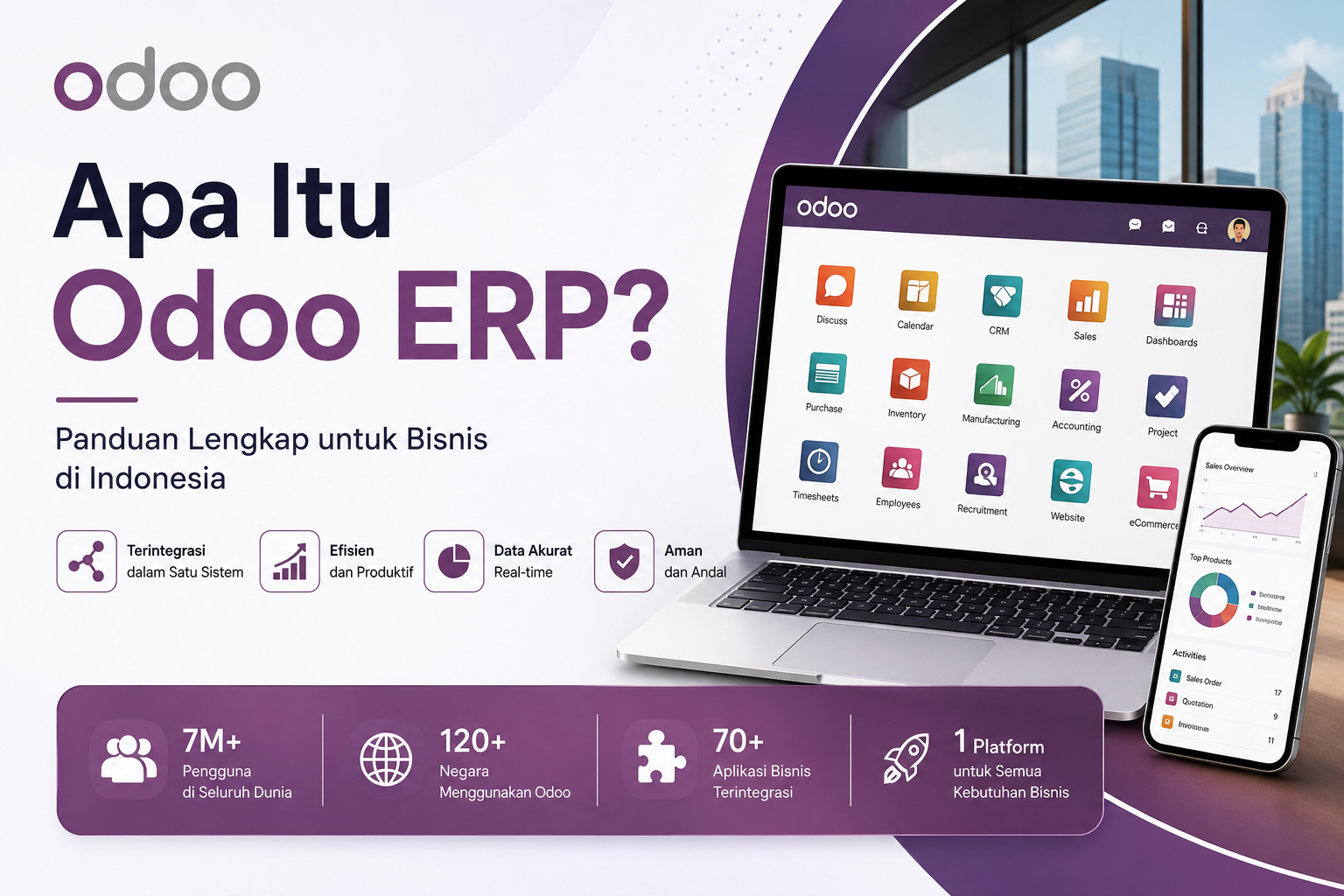
Many companies still use separate applications to manage sales, warehouse, purchasing, and finance. As a result, data is often unsynchronized, work becomes repetitive, and report generation takes longer.
This is where Enterprise Resource Planning (ERP) plays a role. ERP integrates all business processes into a single system, making operations more efficient. One ERP solution widely adopted by companies of various types is Odoo ERP.
What Is Odoo ERP?
Odoo ERP is a modular business management platform that provides various applications to manage company operations within a single integrated system.
Each module is interconnected, so data only needs to be entered once and can be used by multiple departments. This approach helps reduce input errors, speeds up workflows, and improves information accuracy across the enterprise.
Core Modules of Odoo ERP
Odoo offers a variety of modules that can be selected based on business needs, including:
CRM – Managing prospects and customer relationships.
Sales – Managing offers, quotations, and the sales process.
Purchase – Handling purchases and supplier management.
Inventory – Managing stock, warehouses, and goods movements.
Accounting – Recording transactions and managing company finances.
Manufacturing (MRP) – Supporting production processes and manufacturing planning.
HR – Managing employee data, attendance, and HR administration.
Project – Managing tasks and projects in a structured manner.
Website & eCommerce – Building corporate websites and online stores.
Because it is modular, companies do not have to use all modules at once. Implementation can be staged according to business needs and growth.
Benefits of Using Odoo ERP
Implementing Odoo provides several benefits for companies, including:
Integrating all business data into a single system.
Reducing manual work and repetitive data entry.
Accelerating reporting processes and decision-making.
Making workflows more structured.
Easily scalable as the business grows.
With an integrated system, each department can work with the same data, making coordination more effective.
Which Businesses Are Suited for Odoo?
Odoo can be applied across various industries, such as:
Distributor
Manufacturing
Retail
Services and Consulting
Contracting
Project‑based companies
Fundamentally, any company with cross‑departmental business processes can leverage Odoo to improve operational efficiency and data management.
Odoo Community or Enterprise?
Odoo is available in two editions:
Odoo Community
An open source version that can be used without licensing fees and already includes key features for business operational needs.
Odoo Enterprise
A paid version that offers additional features, official updates, and direct support from Odoo.
Choosing an edition should align with the company's needs, business process complexity, and the number of users who will use the system.
When Does a Company Need ERP?
Companies typically need ERP when they encounter conditions such as:
Data scattered across multiple applications.
Over‑reliance on spreadsheets.
Many processes are still manual.
Stock management becomes hard to monitor.
Report generation takes a long time.
The volume of transactions keeps increasing.
If several of these conditions arise, implementing ERP can be a strategic step to boost efficiency and support business growth.
Conclusion
Odoo ERP is a solution that helps companies integrate all business processes into a single platform. With modules such as CRM, Sales, Purchase, Inventory, Accounting, Manufacturing, HR, and Project, Odoo can be tailored to the needs of various industries.
The success of an ERP implementation is not determined by the number of modules used, but by the system's ability to solve business challenges, improve operational efficiency, and enable faster, more accurate decision‑making.